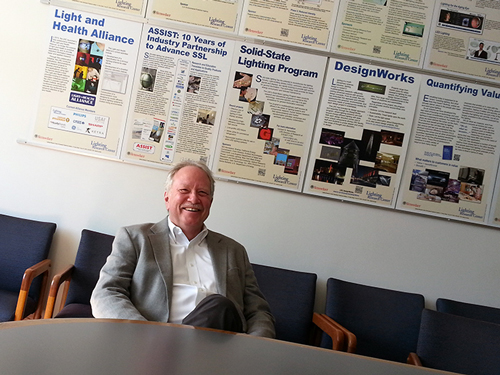
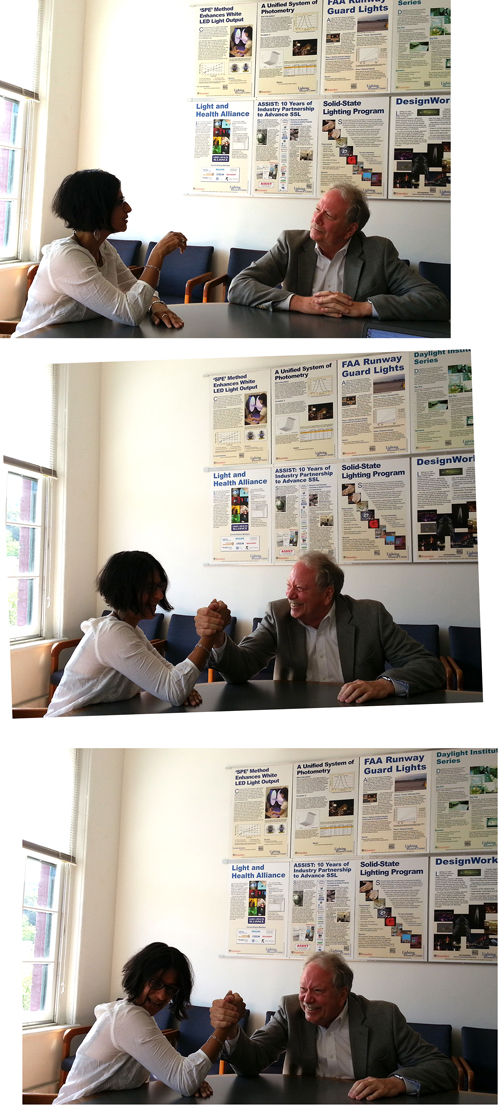
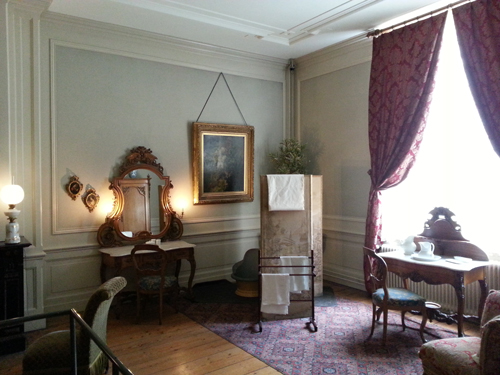
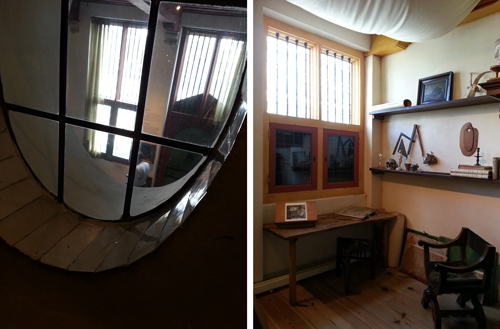
Målet med förra årets resa till Troy, New York, var att under ett par veckor i juni besöka Lighting Research Center. Besöket resulterade i bland annat en intervju med dåvarande chefen occh den erkända ljusforskaren Mark Rea. Han jobbar kvar och är en av ca 35 medarbetare. Ett stort ljusforskningcentrum med andra ord. Besök gärna deras hemsida som innehåller både forskningsartiklar och designtips för hur man kan planera belysningen i sitt hem. En kort tid efter mitt besök tog Mariana Figueiro över ledarskapet. Intervjun med Mark publiceras här på engelska och läsaren får veta mer om hans utbildning, undervisningsmetoder och forskning. Intervjun finns även publicerad på Bright Lights.
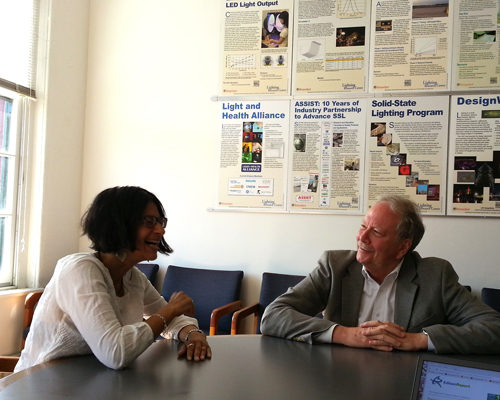
Interview with Professor Mark Rea (MR), 5th June 2017
Interviewer: Kiran Maini Gerhardsson (KMG)
Location: At the Lighting Research Center in the conference room on the 3rd floor in the historic Gurley Building, Troy, NY.
Training and career history
KMG: The interview is taking place on the third floor at Lighting Research Center in Troy, NY. You are a professor of Architecture and Cognitive Science, and you have been working here as the director of the Lighting Research Center (LRC) and at the Rensselaer Polytechnic Institute (RPI) since 1988 doing research on lighting and teaching about lighting. First, briefly, what is your research about?
MR: I’m involved in many different areas, but there are two motivations behind the research I undertake. First, I have to serve the needs of our stakeholders and second I like to understand the basics of how light affects people. This second motivation goes back to my education in graduate school which was looking at the biophysics of light and how the retina converts photons into electrical signals. I guess that educational experience is at the core of much of what I like to do. However, the best projects are those that meet both motivations. The trick is to get funded projects that let us understand how the brain and retina respond to light.
KMG: What students do you teach – graduate or post graduate students?
MR: Generally graduate students, but rarely people that have a biophysics background. After all, this is a lighting center, so we almost invariably get students that are interested in applications. My job is to figure out what they are good at and then provide an opportunity where they can learn what underlies an application. A lot of what I do is try to get them to have a feeling for the bridge between science and applications.
KMG: Yes, I noticed that in the studio which I share with the interns. They all have different backgrounds.
KMG: So how did you get to where you are today? Let us start with your training and post-graduate studies.
MR: Perhaps every PhD student is unclear about what they are going to do on graduation. I was no different. I had three job offers, two of which were working in ophthalmology and one was at the National Research Council Canada (NRC) in Ottawa doing energy efficient lighting. As a graduate student I met Dr. Alan Levy, the person who hired me at NRC. He visited our lab at Ohio State University because at the time there was a big debate about how much light you need in offices and schools. The debate was driven by the amount of energy devoted to lighting in buildings. The notion was that we were over-lighting our schools and offices. The central question was, how low could the light levels be reduced before people started to lose productivity. Alan wanted to answer this question, so he hired me to help.
KMG: When was this?
MR: 1978.
KMG: So this was after you graduated and got your PhD. What was your thesis about?
MR: Colour vision, which was not directly related to lighting and productivity, but I had work with Dr. Stanley Smith who was centrally involved in the debate. This was how I became familiar with the area.
KMG: You took the offer in Canada…
MR: There was a lot of changes going on in scientific careers at the time. Generally, if you had an academic job you taught a few courses, you had a couple of graduate students and published a few papers each year. That model was going away when I graduated because there was a lot more new PhDs looking for jobs. At the NRC it was still very old fashioned. I went there at 27 and they give me a lab, a technician, a budget, and I could pretty much do anything I thought was needed to understand the lighting and productivity debate. I just showed up one day and had all the resources I needed to begin a career.
KMG: And human resources?
MR: Yes, I was given a technician and, like my colleagues, had a secretary for our group. So there was a lot of support for a new PhD. It was a great place to start.
KMG: What did you typically do at the NRC in Canada?
MR: The mandate was to develop a computational model for how quickly and accurately people could read materials like those found in offices and schools. That was the central piece of research that I did. But I worked in a group that was interested more broadly in energy efficiency for buildings, so I did work on lighting controls, both daylight and occupancy sensors, but the central research was modelling visual performance.
KMG: For how long did you work in Canada?
MR: I was at NRC for 10 years, but during that time I also spent a year in England with Peter Boyce. That was in 1985, but I left NRC in 1988 to take the Director job at LRC.
KMG: Where in England?
MR: At Capenhurst. It is where the Electricity Council Research Centre was located; it was right next to the British Nuclear Fuels facility. I had known Peter for about 5 years, and I invited myself to spend a year with him. Peter is very gracious and was a perfect host for my sabbatical. By 1985 he was a well-established and respected researcher, so it was a real opportunity for me to work with him.
KMG: Would you say that your subject area, which is lighting, was a choice of your own or of others?
MR: Not many people set out to work in lighting. Nearly everybody I know, including myself, just sort of fell into it. The route that most of my friends in graduate school took was to continue working in vision science, either in academia or in ophthalmology. But the job in Canada seemed like a fun idea. I thought it would be a good cultural experience for a year; I stayed ten. None of my fellow graduates students got into lighting, and I probably wouldn’t have if the job had been in the US where I had spent my entire life.
KMG: Did you have any turning point in your career, for example, a point when you made an important decision which clearly affected your line of work/research career?
MR: Going to Canada was a big deal. NRC was a fantastic place to begin a career and a family; my kids were born there. But it was certainly not the normal trajectory for graduates with my background. While at NRC Mike Ouellette and I developed the computational model of relative visual performance (RVP) which helped establish our reputation in lighting. The next thing that really impacted me was the year I spent in England with Peter. You see when you have my background you tend to be a little snobbish.
KMG: Because of your background in biophysics?
MR: Yes, so I thought there is a right way to do research. What I learned from Peter was that there are many approaches. In 1985 the ECRC was trying to increase electrical load, not to save energy, so they promoted 200 W halogen torchieres. And Peter went around to houses with these torchieres, put them in the family’s living room and proceeded to conduct a survey about what they thought about these torchieres.
KMG: What is a torchiere?
MR: Essentially is a “fireball on a stick”. It is a pole with a big metal reflector pan at the top housing a high-wattage halogen lamp. It is a floor-standing, indirect lighting fixture. They were outlawed in dormitories during the 1990s in the US because students put wet clothing on the metal pan to dry. Well eventually, the clothes caught fire. Anyway, Peter took me around to these houses and I had a chance to listen to him interview people in their homes. That was so far from what I considered research – research had to be conducted in the laboratory with carefully controlled stimulus conditions. What Peter taught me was to have a much more liberal view on science where researchers can ask a wide range of interesting questions. Peter and I did a lot of work together that year. We continued the work on visual performance and we did what I think was a very important study on security lighting as well as some other investigations. It was an impactful year for me. But clearly 1988 was the most important year for me. I came to the LRC to become its Director. The biggest thing for me was the shift from being a researcher to “being responsible”.
KMG: And the LRC has grown. How many were you from the start?
MR: I was not the first employee, although I was the first Director. Professors Russ Leslie and Walter Kroner in the School Architecture won the grant to start the LRC. Wally was the interim Director and Russ was, and still is, the Associate Director. They had hired one researcher and one executive assistant right after the grant was awarded and these people were here at the LRC before I arrived. Today we are nearly 40 people.

Teaching activities
KMG: I have some questions about your teaching activities and your role as a teacher because I know you do a lot of teaching. Who, would you say has inspired you as a teacher? Anyone in the literature, lighting designers, researchers…
MR: Interestingly, Russ and I had a similar undergraduate education; we were both Liberal Arts majors. That is not a very popular academic endeavor these days, but at the time it was a major for students who did not quite know what they wanted to do. We got languages, science, history, and even physical education. During my undergraduate years I changed major several times, from law to philosophy to psychology. While I was figuring out what I wanted to do when I graduated, I got introduced to many ways of thinking. That liberal arts approach has strongly influenced our curriculum. In most lighting education programs, there is only one professor. In contrast, we have 12 to 15 teaching faculty coming from architecture, engineering and science. So our whole teaching philosophy has been to create a liberal arts program in lighting. Every student that comes through our program gets introduced to courses in leadership, human factors, statistics, and physics as well as to lighting design and engineering. And they get introduced to this wide range of topics by an expert in the area. I don’t believe there is another program like ours where a student has access to this number of professors with a central interest in lighting and, importantly, to state of the art lighting research. In fact, we see education and research as two sides of the same coin. That philosophy is something I wanted to create at the LRC from the very beginning.
If I can say one more thing, I think this liberal arts philosophy of education makes new areas or research less frightening. Often researchers get really good in one area, and spend their careers on the same topic. The LRC is not that way. We pioneered much of the work in predicting LED performance, mesopic vision, color rendering and the health aspects of lighting. Our latest initiative is looking how light affects plant diseases. Plant diseases are becoming more and more problematic for horticulture. Through our colleagues at Cornell University, we became aware of how light could help combat these diseases. Although, I had never been exposed to plant pathology, I believe we can meaningfully contribute to this field through our basic understanding of how light affects biological sensor systems. I believe a liberal arts education provides the foundation as well as the courage to take on new scientific challenges.
KMG: So true. What course literature do you use?
MR: There is so much literature, that has to be customized for the students. Particularly when creating a lighting curriculum, you have to sort through the vast amount of reading materials for the students and tell them a “story” that communicates fundamental concepts. The “story” gives a framework for retention of those concepts.
KMG: How much do you teach?
MR: Well, this year is a sabbatical year so zero this year.
KMG: So you can devote your time to research?
MR: Right. But I will teach in three or four classes. The courses I have been centrally involved with are in two areas. One is basic experimental methods – how do you design an experiment. I liken it to architectural design, there are some ugly experiments as well as ugly buildings. How do to design an elegant experiment to answer a scientific question is key. The other area is leadership. What we discovered a few years after we started our graduate education program in 1990 was that students were so focused on the technical topics being taught that they had no time to think about the context of the lighting industry or the world at large. Exposing them to the real world realities, even if it is only a one-semester course, helps them transition to the work environment. Knowing a little about the significance of markets or how to develop a budget enables them to have a better interview.
KMG: Are these undergraduate or graduate students?
MR: Every course I teach is at the graduate level – master or PhD.
KMG: Being an architect, I would like to know more about your teaching to architecture students.
MR: What would you like to know?
KMG: How much lighting do they have in the programme? What gets their attention, do they find interesting or difficult? Their expectations and your expectations – what do you want them to know.
MR: Obviously it is a many textured answer. To be a licensed architect in New York, a week’s training in lighting is all they need, but they really learn nothing about lighting other than the difference between a fluorescent lamp and an LED. However, we have a programme at RPI at the School of Architecture where the students can, essentially, add a speciality in lighting with their degree in architecture.
KMG: Only one week?
MR: That’s it. Lighting does not seem that important to architecture faculty and professionals. What is good about our program is that the students who graduate with a speciality in lighting, in addition to their architectural degree, have unique capabilities on their resume. So they can differentiate themselves when they look for their first job. They can say “Well I know something about lighting in addition to architecture” and that seems to put them in good stead for employment.
KMG: How many students take the speciality?
MR: Probably no more than six a year, sometimes it is three. But we always have some architecture students who have a minor in lighting.
KMG: Have you taught them earlier in their education?
MR: No, that would be an undergraduate course. Ours is still a graduate course but some undergraduate architects can take lighting courses in their fifth year. So you asked about what we teach them. They usually take technology, human factors and light and health courses because those are the ones that are more relevant to understanding how people interact with spaces and light.
KMG: Lighting is multi-dimensional – you have the light source, the objects receiving the light, and the observer looking at the illuminated object in the space. So how do you make architecture students interested in all those three aspects of lighting?
MR: That is an interesting choice of words – how do you make them interested. I do not know if you can make anyone interested. I guess the unspoken expectation is that I am going to give them high-level information. At the LRC we differentiate between training and education. Training would be showing students how to do the lumen method and how many watts are required by a particular application. But we have always, particularly in a research organization, taken the view is to ask the right question. So when I teach architecture students it is about engaging them, hopefully I do not make them interested, to ask better questions about lighting. Why do I have to provide 300 lx on a horizontal surface? They would probably never otherwise stop to think about why lighting recommendations are what they are. And then once I get them to ask better questions, I try to answer it in a practical way. Hopefully, these educational moments move them from thinking of lighting as a technology to thinking about lighting as construct for aesthetics, productivity and well-being. Some do become sufficiently interested in lighting that they make it a central part of their career.
KMG: Would you say that your pedagogy has changed over the years?
MR: Definitely yes. I am cartooning this so I really do not entirely believe what I am about to tell you. It used to be that our goal was simply to open up their heads, pour in information, close them back up and send them out to find jobs. Because we had so much information to covey, a lot of our courses were just training. My thinking has changed in that I am trying much more and instil a cerebral culture inside their heads that feels natural to ask questions. Why am I doing this; is this the right way to meet the design objectives? Take parking lots. My guess is that most architects would just draw a rectangle with dots indicating the location of lighting poles and think they are done. But what are you trying to do with this parking lot? If you are a good architect you will think about where to put the parking lot, how will people get access to it and so on. Another layer of questions relate to “how do I light it”, “why do I light it this way instead of something else?” I would like to think, maybe I am flattering myself, that the students who go through our program will ask those kinds of questions. I think – again to oversimplify – that a lot of architects will take whatever the engineers tell them they need. I would like to think that the students who come out of the LRC would not do that and would not be satisfied if the engineer simply “met code”. I hope they would ask, “Well, is that the best you can do?”
KMG: So, to be aware and question things?
MR: You have to have the culture inside your head to ask those questions and feel confident that you can ask those questions. You do not have to trust the engineers.
KMG: Have you seen any projects that the architecture students have done? Because these courses you give are in the last year, right?
MR: Some architectural students have gone, in fact, into architectural lighting. They have left architecture and have gone into lighting design firms. They have a whole legacy of projects.
KMG: How many PhD students do you supervise, at the moment?
MR: At the moment none, normally, no more than two. It may sound like I am lazy, but as a center director you lead and manage many research projects. I try to diversify my responsibilities and maintain a balance for the many important things associated with a research center. So taking five students would probably tip the scale too much in that direction. So I try to be effective in many areas rather than concentrating on one area, like supervising graduate students.
KMG: Sounds like a good strategy. Do the PhD students apply for any special programs?
MR: Yes. Usually they have preconceived ideas about their area of study and the professor they want to work with.
KMG: Do they follow a predetermined project plan or do they formulate the research questions and design the research?
MR: No. Because we are running 50 projects funded from by outside sponsors we have to be efficient. We have to make sure the students are working on funded projects. Now that does not mean they can’t exhibit creativity. One thing I learned very early on is that it really does not matter what problem you work on; it’s up to you to make it an interesting problem. So we try to carry that philosophy to our students. Students are generally not mature enough to ask good questions – professors usually ask better questions. What we do is try to establish the perimeter for a problem and get them to ask good questions within that framework, usually a funded project or a program that we are working on. Not every project they work on is funded, but most are. So rarely will the student come in and define her own project. They simply do not have the maturity to ask good questions. Having said that, the worst thing you can do is tell the student what to do. But, again, you have to give them a manageable uncertainty within the problem perimeter so they can work their way through to a solution. That is what we try to do. But of course when they are not making any progress or they need to move in a slightly different direction we have to narrow the perimeter so they can solve the problem on their own.
KMG: So moving forward…
MR: Before we do that, my impression of our conversation is that you feel unfulfilled with our dialogue about architecture students.
KMG: I just think it is a challenge to get architecture students interested in all aspects of lighting. I think a lot about what would be the appropriate assignments or exercises to get them interested.
MR: Well, the beauty of lighting is that you can take any path you want. Think about the diversity of the work we do here. You can try to understand the physics of light, how plants are going to respond to light, how to improve health outcomes for premature infants, and how it increase safety for automobiles and airplanes. We try to provide an education program that lets the students follow their natural instincts. I mean if you look at someone like Mariana [Figueiro], for example…
KMG: Yes, she is an architect…
MR: What she ended up following was more of the medical side of lighting. Because of the culture she came from medicine was not really an option for her. But clearly what she did is, by coming here, follow what she cared more about which was to see how light improves quality of life for cancer and Alzheimer patients. My own view is that if you can get the students emotionally involved in lighting, give them some basic information, and nurture their natural instincts we can change the world. I believe a center as large as ours enables students to do that, and Mariana is a perfect example of someone who followed her instincts and changed the world.
KMG: This is unique, what you have here at the LRC, of course.
MR: It is, and again it comes back to our liberal arts philosophy. Liberal arts is not training you for something but showing you the wide-wide world, and then providing you the tools and support to follow your passions and instincts. But if the student is never exposed to the diversity of lighting, they do not even know there are options. Mariana would not have naturally thought that she would get into medicine through architectural lighting.
As a center director I believe I have to create an environment where people can follow what they are good at. Trying to get people that do not like something or are not suited for something, and trying to force them to follow that is a less productive way than me helping them find a path that is fulfilling to them. That is really our philosophy of education here. Fortunately, we have the skill sets to teach people, probably better than most places, about the physics of light, plants human factors, how the retina works, colour vision, design – all of those things are uniquely found in this place. I am hoping that you, after your two weeks here at the LRC, you can see possibilities that you might want to develop, ones that you might not otherwise have seen.
KMG: I am so impressed with all the different things you do.
MR: But that is the point – light touches everything.
Lighting research and publications
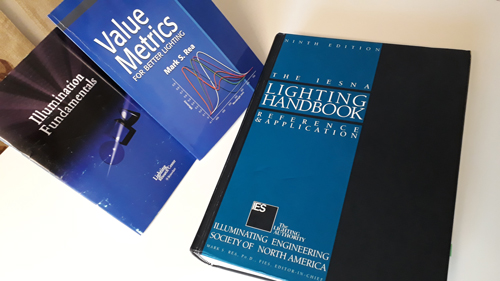
KMG: Moving on to your lighting research and publications. I enjoyed reading your book, “Value Metrics. For better lighting” (2013), because it has a clear statement, and was not just another book about lighting. This is in short how I understood the message:
Our society undervalues light because we do not properly measure the benefits of lighting – because we do what we measure. So, the way we measure various characteristics of illumination are crucial for creating good lighting. But today’s lighting measurement systems are inadequate since the perceived lighting qualities depend on the light source, the illuminated object, and the person perceiving the object. Lighting is multi-dimensional, and to improve lighting, that is, to add value, the benefits as well as the costs must be taken into consideration. The benefits will vary depending on the context, for example, the activity performed – if you are looking to buy fruit or if you are looking at a painting. One problem is that light meters today are based only on how a standard observer detects light during the day when the cones are activated by plenty of light, or more precisely the L (long wavelength-sensitive) and M cones. Whereas sound meters have several filters, light meters only have one filter that models human brightness sensitivity. This filter, the photopic luminous efficiency function, does, for example, not consider the non-visual effects, such as circadian rhythmicity. Other problems are the way colour properties of light are measured and how colours of objects appear. So you propose new metrics for measuring light and colour, such as a “circadian illuminance” – a weighting function to be used at a minimum illuminance level of 100 lx – and “Class A” colour.
Anything you want to add to my short summary?
MR: No, you have got the essence. This lack of appreciation of the significance of the benefits of lighting is sort of my millstone that I have been dragging around with me for my whole career. It is so sad. Because we do what we measure, the only measure is horizontal illuminance and we think we are done. It is funny how people who you talk to kind of know it is wrong but it is an industry, or community, that really does not control its own destiny. I think lighting could be such a much more powerful field if people understood the complexity from every level that you have. There are people who generally understand little pieces of it. I mean, think about it… The thing that drives me crazy is roadway safety. We, at the LRC, know how to light our roads to demonstrably improve safety, but we cannot get people to “move”.
KMG: By move, you mean to change the way things are done?
MR: Yes. We, as a community, are not fulfilling our social obligation as professionals to deliver safety on the roadway. It is appalling, I think. Like I said it is my millstone, and I do not know how to change it. I have naively assumed that if we show the lighting community the research, show them how to do it, how to make the measurements, they will do it – but they do not do it. There is also a financial incentive to change lighting practice because once lighting delivers fewer crashes, the benefit, the value of lighting to society increases.
KMG: But why is it that difficult to change things. For example the sound meters have got filters. And sound is complex.
MR: There is no technical barrier. The portable spectroradiometers that people have now with software – there is no reason not to. It is a social problem, not a technical problem.
KMG: Your book is kind of a debate article. And you wrote the book for the celebration of LRCs 25th year. Was the anniversary the only reason? Why did you write the book?
MR: I was asked to by SPIE. I gave an interview one time when I was at one of their conferences. They asked me to write a book and it was our 25th anniversary, so I said “sure”. But it goes back to what I said back before. A lot of my teaching is based upon assembling one paper here and another paper there to tell a “story” in a course. So this book was a chance to put everything together into a “story.”
KMG: Besides this book you wrote the book “Lighting fundamentals”. You were also the editor-in-chief of the Illuminating Society of North America (IESNA) Lighting handbook. When you write books you reach a different audience – maybe policy makers and practitioners. Who reads the scientific articles besides the scientific community?
MR: That is an interesting question and you dig into something fundamental about the LRC. When you are working in such diverse fields as we do whether it is aviation, traffic safety, light and health or whatever, you do not have a common community. Those people do not talk to each other. We have to network with everybody. But they do not see – let us say aviation – they do not see lighting as more than just a small part of what they do. And in plants it is only a small part of what they do. So the commonality is us. We do not cater to the lighting community per se. We cater to the people that use lighting and not the people that produce it. That has been our business model. So a book like this (Value Metrics) is catering to a lighting community that in some respects none of us are working in. In other words, someone in aviation would not want to read the book, or someone in plants. Why would they bother? It’s not about airplanes or plants. So I think of lighting as a field because it touches everything. However, we in the lighting community have to get our house in order before it will be a field. I would hope that the book helps frame better questions for lighting than those we asking right now.
KMG: So which was the intended audience when you wrote that?
MR: Me.
KMG: …and me.
MR: Well, sometimes you just got to get it off your chest. And somebody at SPIE flattered me and asked me to write it.
KMG: You have written more than 250 scientific and technical articles related to vision, lighting engineering, and human factors. Any publication you are particularly proud of?
MR: I am going to name a couple but you may not be able to extract the commonality in all of them. Probably the first in 1986 was the model of relative visual performance that got further developed and published in 1991. That publication was the capstone of the research we did at NRC. It represented why I came to Canada.
I think the work we did here at the LRC on mesopic, off-axis detection was also important because people were chasing their tails for 30 years trying to define mesopic spectral sensitivity [i.e. vision in low but not quite dark lighting situations]. We basically asked the question “How does the spectral sensitivity of the peripheral retina change with light level?” We developed the first computational model for off-axis detection which then led to the system adopted by the CIE (International Illumination Society). That model was published in 2004 (“A proposed unified system of photometry”)
About that same time Jean Paul [Freyssinier] and I were working on colour rendering. People kept using the same old tricks trying to characterize the colour rendering properties of light sources. I believe Jean Paul and I framed the right question about how to do that more accurately. I mentioned that in the book that colour rendering index (CRI) is limited because of the fundamentals of colorimetry. So Jean Paul and I asked the question about what do the people really respond to? We realized that there were two dimensions to colour rendering: one had to do with making sure you do not deviate too far from broadband spectrum and one that was related to color vividness. I always describe the two-metric approach as related to the taste of scrambled eggs. You want the eggs to taste unspoiled and natural but you usually also want to add some spice to the eggs to have them taste better. The two-metric colour rendering system is like that. It helps ensure that objects don’t look unnatural but, depending upon your preference, color saturation can be increased. The two-metric approach to colour rendering has now become common knowledge in lighting. The other piece of research we did was related to the appearance of illumination from a light source. Surprisingly, no one knew what white illumination was. So we developed the “white body” concept. I put that in air quotes because chromaticities on the “white body” look slightly different but they all have minimum tint for a given CCT. We coined the term “class A” light sources for those which provided good two-metric colour rendering as well as “white” illumination. Although different people and cultures have different preferences for how much “spice they want in their scrambled eggs,” they consistently like “class A” light sources.
But at the top of my list is probably the 2005 paper that we did (Mariana Figueiro, John Bullough, Andrew Bierman, A model of phototransduction by the human circadian system) on circadian phototransduction. The reason is that it went right back to my education in graduate school. By looking at the basic neurophysiology of the retina and the psychophysical data, it was possible to piece together a comprehensive model. There is no literature, after a dozen years that shows the model is wrong. Obviously, it is only a model and new insights will undoubtedly be gained, but I don’t think the model fundamentals will change dramatically.
If you look at all those papers, what I consider to be reasonable milestones in my research career, they are all about developing an understanding of how neural systems work and providing a computational model that predicts a human response to light. In my opinion, any value proposition, whether it is road safety, performance and productivity, circadian regulation, or colour appreciation, must be based on a fundamental understanding of how the retina and the brain process light. That was the commonality.
KMG: In your own research, do you remember the last time you were surprised by the research results? Something you did not anticipate.
MR: There are things that do not turn out as expected. I will give you one example. We had a project by the Federal Aviation Administration and they wanted to know how bright signal lights had to be for a pilot to find a remote airfield land the airplane at night. To find the airport in the dark the pilot needs to useoff-axis, rod receptors.
KMG: The peripheral vision.
MR: Yes, and rods have a different spectral sensitivity than cones in the fovea on which V-lambda is based. Then, once you detect something is there, you have to put your fovea on it to decide if it’s a star or an airfield. So there is really a two-step process when you are pilot in rural Alaska trying to find a place to land. You have to first detect the airfield and then you have to decide if you are lined up with the runway or not. So you are shifting the visual task from the periphery to the fovea. The thing that surprised me was how easy it was to model that. We modelled the first part with off-axis detection and the spectral sensitivity or rods. And then identification of the airfield shifts over to a foveal, V-lambda response. The fact that your total time to do detection and identification was the simple sum of what you would expect from simply adding the reaction times from the two tasks, as if they were independent – that surprised me. It seems that this complex task is done in a sequence. It just takes time to find it and then decide what it is. I thought would have been more complicated.
KMG: We want surprises…
MR: Well, pleasant ones.
KMG: What is your comment on the following statement:
Providing good lighting in home environments can be more challenging than workplaces because:
- Home life includes different kinds of activities,
- lighting preferences among residents will vary significantly depending on age and health conditions,
- home life includes light as well as dark patterns as opposed to life at the workplace,
- sleep (that takes place at home) will affect work performance,
- and because flexible work life also means that work activities are performed in the home.
MR: The difference between home and work, as I see it, depends upon whether you have a homogeneous lifestyle or not. For people who live in senior housing, for example, their day-to-day activities are more alike than that of a teenager who attends school with a variety of classrooms, athletic events and social activities. Even in the same room, you can have different light experiences – you and I have are in the same room talking, but we have very different light exposures. Sorting through the variability across the day and night on a person-to-person basis is a difficult thing. Broadly speaking, however, the more critical times are in the beginning and end of the day. These are the awake times when light exposure can have the biggest effect on circadian rhythms. So because we are at home the very beginning of the day and the end of the day, I would agree with your statement. But every photon counts. What we find in our research is that people with busy lifestyles experience circadian disruption because Tuesday is not like Wednesday which is not like Thursday. The variability is generally associated with the middle of the day with some type of work. So a more consistent home lighting could help dampen the working environment variability. That’s certainly worth thinking more about.
KMG: But at home, there can be children, old people, sick people that you do not have in the workplace.
MR: Yes, but what I am saying is that variability is the question. I can get variable lighting at work, I can get variable lighting at home. The real question is not so much the environment but how homogeneous is your lifestyle. And if that variability occurs at work I agree with you, if it occurs at home I disagree with you.
KMG: I get your point. Still, you agree that homes can be challenging. Why, then, has home lighting received so little research interest?
MR: What do you mean? Swedish Healthy Home – we have a whole programme.
KMG: Well, I mean until now. But you mentioned that you and Peter Boyce did some research in British homes. And that is unusual. I did not find many studies when I reviewed previous research. I was happy to read the article you wrote with Mariana (2014) about office lighting and personal light exposures in two seasons and the effect on mood and sleep. You included sleep, which is an activity in the home environment. As I see it, work life and life at home are integrated.
MR: I agree with you. People ask me questions about school lighting and I am always quick to say: you can do something with the lighting in schools but if you do not control what is going on in the home you might as well not waste your money. The reason, I think you already know this, the Swedish Healthy Home is focused on the home is because that is the place just before bed, that is when your light exposure takes a timeout. And if you can control what is happening there then you can better predict what needs to happen the next day. The assessment of circadian regulation has to be at home, the last thing that you do during the day.
KMG: And the morning as well?
MR: I wish I could give you a definitive answer here, what appears to be true, you do not necessarily have to have a really bright light in the morning – you can stretch light exposure throughout during the day. As long as you have a robust 24-hour cycle of light and dark, people will entrain. So we find that in the Swedish environment in the winter time, for example, there is almost no light at home when they get up. They get their entraining light, at work, in the middle of the day in the office. The trouble is that light levels are often so low that people cannot entrain to it very well. But it turns out that the middle-of-the-day bump in the light that you get is often the entraining stimulus for people in Sweden. Not at home.
Research funding
KMG: The LRC has a number of partner organizations, for example, lighting manufacturers. Do you get any other funding, for example, governmental funding?
MR: We get about 15–20% from industry, nearly all the rest is from government agencies: Federal Aviation Administration, US Navy… And we get about 5–10% from the university and I think that is one of the differences. Every other lighting research center that I am aware of has a more dominant fraction of support from their home institution. We have less than 10% from our home institution. So everything we do here is funded from outside sources to support those 35 faculty and students. We have come to learn that it is important to do good science, but that science has to be translated into practice. If you are not working closely to industry there is no impact. So our partners are critical in that whole translational philosophy that we have here.
KMG: Do the LRC partners suggest research topics?
MR: Yes. It is a real dialogue. It is not like, we thought of this great idea. Would you please give us money? It does not work that way. Generally, they are involved in the planning – where is the industry going, what are the issues, what should we be working on, and what is your advice? So we interact with them to help set our research agenda that meets their needs.
KMG: They have changed over the years, have they not? But some of the organisations and industry partners have been involved from the start.
MR: The only one that has been with us from the start has been New York State Energy and Research Development Authority (NYSERDA).
KMG: So governmental funding is crucial to you. Do you have any idea of what the Trump administration will propose in their budget?
MR: I am not sure that anybody does at this point.
KMG: What would you say is the greatest lighting challenge in your research field? I know the field is broad and your book Value Metrics gives some answers…
MR: Let me reframe my answer. Sociology is the biggest problem. By that I mean… There is an old cartoon called Pogo and the phrase is: “we have met the enemy and he is us”. We are disorganised, we are underfunded as a lighting community, we do not trust each other, government does not trust industry and vice versa, nobody trusts academia. There is no cohesive pulling together for a common purpose. I consider that a sociological problem. What I wish we would do more often is try to find a more cohesive common strategy. I think lighting has such a huge potential because it touches every aspect of life, and yet as an industry we are petty and underfunded, we bicker all the time. It is just a sad thing. The LRC is kind of an oasis from that bickering, and we like each other.
KMG: Do you mean the employees or the partners?
MR: Yes, the faculty staff, and I think too the close sponsors like the partners. I think we really enjoy our interactions, but because you enjoy the oasis you never want to leave. So I do not think we have nearly the impact we should have. I think we have to be more deliberate in our interactions with society. So, shame on me for not taking on that greater responsibility.
KMG: The staff here at the LRC have they come directly from academia or have they worked outside the academia before they were employed here?
MR: It is an interesting question. Rarely, have they come straight from academia, except those who graduated from our own program. They usually come from a totally different background.
About terminology central to lighting and to your book “Value Metrics”
KMG: What do you think of the term “human centric lighting” that was chosen by industry to describe adaptable or dynamic lighting with LED-technology? (human-centred)
MR: What is the point of lighting unless you are lighting for people? I do not have any emotional response to that term – it just seems obvious to me.
KMG: A parallel to me is “human-centred architecture” and that is just as strange to me because architecture is about creating spaces for people.
MR: Maybe it is a good way to remind us why there is lighting in the first place.
KMG: So returning to your book, I have some more detailed questions. How does the spectral sensitivity curve, or “circadian light” function, compare to what has been done in the Lucas Group at the University of Manchester. They talk about melanopic illuminance, and to me, that seems to be the same as circadian light.
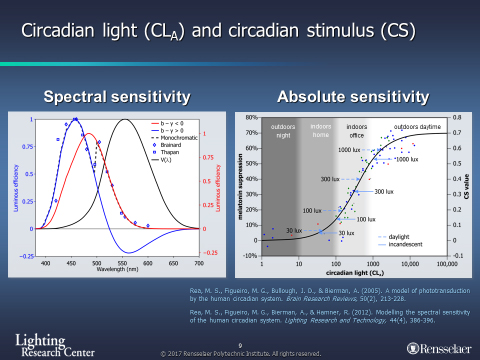
MR: Here is where I would like to make this a dialogue rather than give you an answer because I do not understand why anybody would consider melanopic lux as circadian light on first principles. First of all, the brain has no direct access to the retinal photopigments, like melanopsin.
KMG: No, because the signals pass through the channels.
MR: That is right. So how are you going to get from melanopsin in the retina to the biological clock in the brain. It just seems prima facie wrong and it does not describe the empirical data. But on just first principles I would never start on a model that was based on a single photopigment because signals generated by a photoreceptor have to be processed by the neurons that come after it. And if you do not understand how the neurons are processing the receptor signal you cannot generate a spectral sensitivity curve like circadian light. Okay, for sure light is absorbed by melanopsin. So what – what do I do with it? Is there a signal to the clock at all, or is the response at saturation? Where exactly is the response between threshold and saturation? You need a transfer function, like our circadian stimulus function. That is a neurological channel response and not a photoreceptor response. Because we have a transfer function from circadian light to circadian stimulus we can predict circadian system response from threshold to saturation. How are you going to do that with a photopigment spectral sensitivity? With my training, remember biophysics, it would be silly to propose something like that. So you always have to think in terms of a channel and how it responds to light of different spectra and amounts. For an application metric, you simply cannot stop at the photopigment. But “melanopic lux” sounds scientific, right?
KMG: Another thing you wrote about was how the circadian system is not only affected by the intrinsically photosensitive retinal ganglion cells (ipRGC) but also by the rods and the cones.
MR: And the Lucas group said the same thing. I do not even know how people came to this melanopic lux thing. It is not what the paper says. These are pretty good people and they do say that melanopsin is only a photopigment.
MR: Let me reinforce what I said about being sociological. People keep repeating what they hear. So you are repeating what you have heard.
KMG: But how will I know if I do not read what others are writing?
MR: That is right. So I think we as a community should sit down and come to an agreement. But we just keep muddling along.
KMG: Central to your book is value defined as benefits divided by costs. To increase value you can either increase the benefits or reduce the costs (or both). When you discuss costs you refer to monetary costs. But what about the environmental impact that is not included in the cost?
MR: Although they should. Let me be clear. The price you pay for energy and the equipment is not the real cost of lighting. I am not making that argument that price is the same as cost – I just want to be clear. Mercury disposal and global warming are all part of cost not reflected in price. How we can factor all those collateral issues into cost is an important topic when we consider questions such as “Should you put in street lighting?” But we don’t even formally consider the benefits of street lighting. The supposed benefit of street lighting is cost avoidance by reducing automobile crashes, and government agencies have come up with cost of a person’s life. The cost of a 65-year old life is lower than that of a 20-year old because of life expectancy. Now does that mean all 65-year olds are worth less than all 20 year olds. You can make the opposite argument. But the point is that there are approved methods for calculating the cost of a human life. Rarely if ever do agencies go through a value calculation where a complete analysis of the costs and the benefits is undertaken. Our biggest problem in lighting is that we do not measure the costs or the benefits of lighting, particularly the benefits. And that is the point I am trying to make.
KMG: Yes, I get that.
KMG: In your book, when you discuss lighting energy efficiency, I missed one thing. I agree that when two light sources illuminate the same space it is a waste of energy. When we have access to daylight on a task area there is no need for electrical lighting on that same area, e.g. my desk in the studio here at the LRC which gets plenty of daylight through the tall windows of the building. But to create brightness, surface colours matter. Surfaces with low reflectance, e.g. dark furniture and dark wall paint will demand more lighting. So the choice of interior surfaces can increase wasted light. Therefore, architects play an important role. In your book I would have liked to read more about the importance of surface colours. And we do need a lot of light in Sweden during the darker months. Again, lighting is multi-dimensional and you have to consider the light source, the surface and the observer.
MR: So in the theatre, what colour do you paint the walls?
KMG: Well, the choice of surface colours will depend on what you want to achieve, of course.
MR: I was not really interested in lecturing people about what they should do.
KMG: It is not lecturing. It is about creating awareness about what paint can do to your lighting experience. Just as choosing the right light source or using the right sensitivity curve, and the effect that will have.
MR: So the offices just below us have black ceilings.
KMG: Oh, poor guys.
MR: But that is what the architects want.
KMG: We just turned on the lighting in the studio upstairs that has a white ceiling. Only the uplights. Even though there is daylight. Because daylighting is not always enough.
MR: That is right. What I am trying to get across is I can measure what the impact is whatever you decide to do. If you want to paint your walls dark blue, you want to do just uplighting – illuminance on the table is not what I want to measure. It does not tell me whether I like the space or do not like the space. We have to let go of this single criterion of horizontal illuminance on the desk. Abandoning horizontal illuminance as the sole design criterion does not mean we cannot measure anything, it just means we measure the wrong things. But I am not going to tell an architect whether she should or should not have just uplights. Who am I to dictate that? All I try to do is measure what you did. I am not disagreeing with you. I just do not know how I would to write a book on what an architect should do. To me it just seems obvious that if you paint the walls dark it is going to look dark. There is a thing I think people do forget which is that a white wall with a lower illuminance does not look like a dark wall with high illuminance even though the measured luminance is exactly the same. Does that make sense to you? To increase the luminance to what that white wall is I will have to put in a lot more light on the wall get the luminance up. But the rooms are not going to look the same. It is still going to look like a dark room with dark walls – no matter how much light we put in the space. Basically our visual system is a contrast detecting system. We are not good at judging the absolute amount of light. In other words, we cannot judge luminance without a context. So if you really want to get into what a lighting design should be, it is all about contrast – it is not about white walls, it is about the white wall with respect to the table, to the black board and everything else. It gives you a sense of what the room is like.
KMG: Yes, I understand.
About research in general
KMG: This question concerns research ethics. Your main objective is to add more value to lighting through research. Is there any research project or assignment the LRC would not take on?
MR: I can give you the glib answer that science does not have any ethics. It is just understanding how the world works. But clearly we are all human and we are going to judge things. So let us assume that – I am making this up as I go along – we would have to kill a whole bunch of dogs to find an answer to a scientific question. I would not want to do that. In fact, before we can do research with animals or with humans we go through a rigorous, formal review process aimed at protecting animals and humans. Not only wouldn’t I want to do such a study, I could not do that study because of legal obligations. On the other side, I am a big believer in the project we do in Africa to give people light so they can be better educated. But let us assume that what they were reading was something that could hurt mankind, terrorism or something like that. Did I do a bad thing to provide light so people could read in Africa that ultimately led to them understanding how to blow up somebody in London? I do not know. I would like to think reading is a good thing, but no one can control what is being read. But does society want to censor that? Do I really want to say “I am not doing that project because it might lead to terrorism”? You can also think about answering the question the other way around. What are you going to do? I want to help people read in Africa at night because they might learn how to have clean drinking water. I think I come down on it that way. But ethics is a funny thing and is often post-hoc. It is only after something bad happens that you realise it was a bad idea. Most people in science are ethical people, but collateral consequences are difficult to determine before they occur.
KMG: Clearly, it can be hard to know the effects. I mean, look at Oppenheimer.
MR: Yes, the ethics of the atomic bomb is an interesting question. Are you done with it?
KMG: Yes, for now. Here is my next question. You can do several changes to avoid circadian disruption and the changes can be done by society or the individual. I know politics can be difficult to influence but are there any situations where you think more could be accomplished by regulations rather than voluntary market driven actions?
MR: First of all I think it depends on what society you live in. What you do in Sweden might be different than what you do in the United States – with no moral judgment but it just might be different based on expectations. But you know we have seat belt laws here. Why should I have to wear a seat belt if I want to go out and put myself at risk and go through the windshield. That should be up to me on one extreme. On the other extreme somebody has to take care of you when you are braindead. So it is better for society to make you wear seat belts rather than run that risk. No person is an island. Everybody is connected somehow. So I can go either way depending on what culture you are in. In some states in the US, when you ride a motorcycle you do not need a helmet. It is not required. In other states it is required. So again even within the United States you have different views on whether you are going to hurt yourself and if society is responsible for it. So to try and play it middle ground, I would like to see government, first of all, give information. Let us take schools, for example, I think that schools can do the best thing they can in the school but I think it is also the obligation of schools to work with parents because circadian entrainment is a 24-hour phenomenon. Look, if you want your kid to sleep better, it is not just what happens with the lighting in the school. You also need to take some responsibility to have dim light in the evening, to take away the iPad or whatever. That does not mean you have to. I would hate to see government regulating the use of kids’ iPads at home at night, even if it might be good for circadian entrainment. But I consider it to be the government’s responsibility to let people know what the consequences of their behavior are. It is the same thing with drinking water and air pollution. The government’s responsibility is first to let people know what the truth is with regard to an issue like circadian regulation. Whether they come in and take one more step – motorcycle drivers have to wear a helmet, or all kids must turn off their iPads at home – I am not personally comfortable with that.
KMG: You can take shift work, for example. How much shift work do we really need in a society, not counting the police, hospitals and the fire brigade? Do we need shops to be open 24/7?
MR: Yes, shift work is a pretty crummy job, but do we really want all the restaurants to close at six?
KMG: But clearly shift work has effects…
MR: Smoking does, and driving a car does. All things come with risks. Driving is riskier than doing shift work. This is probably a cop-out. Do you know what a cop-out is?
KMG: No.
MR: You do not accept responsibility. I have a privileged life. I get to be a researcher and I do not have to make the hard decisions regarding society. I naturally feel my job is to give people information and how they act upon it is up to them. This is a thing that goes on in science all the time. Should scientists also be advocates for the environment, or whatever is considered to be socially important? I tend not to be an advocate. I tend to be a person who wants to provide information and then let society do what they believe is best. I may not be the best person to ask about these things.
KMG: Well, now I know. So could you give me some information, then, about lighting terminology – terms that are not that clear to me being a non-native English speaker? What do you mean by architectural lighting?
MR: Illuminating the built environment.
KMG: So it refers to the built environment outside as well as inside a building? Is a roadway a built environment to you?
MR: In my mind.
KMG: So it is practically every kind of lighting.
MR: I do not consider a flashlight to be architectural lighting. But roadways for sure. The structures, anything built.
KMG: What would you say characterizes ambient lighting, and how does that compare to general lighting?
MR: It is synonymous.
KMG: Do you think that there are any problems with lighting, which we used to have, that are not as pressing as in the past? We have solved some problems, have we not?
MR: Well one thing the LEDs have done is definitely reduce the power demand. I know Sweden is moving from the incandescent to the LED.
KMG: I would say LEDs are in general accepted judging by the survey we did in Swedish homes, which is good.
MR: Well, as long as the benefits remain the same and we have to keep track of that. It is not just the watts. The CFLs [compact fluorescent lights] did not do the job that incandescent did in terms of people’s acceptance. Some things we cannot measure but somethings we can, such as colour rendering. But anyway, problems we had with lighting. Arguably, mercury was never a huge problem in the 1990s. They used to put a lot of mercury in fluorescent lamps, but not anymore. This century they got it down to fractions of what it was 30 years prior to that. So the use of mercury and its impact on the environment is a lot less than we had before. With LEDs that problem goes away all together. I will go out on a limb here: the fact that we probably have safer outdoor environments now because we can afford the lighting. But there are going to be collateral issues with that, right. You know light pollution.
KMG: So we have new problems.
MR: But from a personal safety point of view we are doing better than we used to. But on the other hand there are all these other collateral impacts that we may or may not have fully understood.
Wrapping up
KMG: I would like to wrap it up now. You travel quite a lot. You do a lot of long-distance jet travel across several time zones. Of course I am curious as to how do handle the adjustment of your body clock. Do you take melatonin?
MR: No, I do not. I would not know when to take it exactly. I have some very simple rules. When I fly from west to east, like if I come to Stockholm, I make sure I do not get a lot of light exposure until, say noon when I am there. And that helps a lot.
KMG: Do you wear sunglasses?
MR: I can. I do, but not in the airplane. I just do not look out the window.
KMG: But before the airplane.
MR: No, I sort of know where my [body]clock is because I can just look at my watch. I know I am on New York time and that my clock is entrained to local time. When I am flying to the west coast I tend to go with the local clock, knowing that I will delay my biological clock naturally. I might have a little trouble in California – it is behind by three hours – but flying west is much easier than flying east.
KMG: So I have it ahead of me when I go back to Sweden, flying east?
MR: So when you go back you will be entrained to Troy time.
KMG: How is the lighting arranged in your home? Does your family share your interest in lighting?
MR: When we built the house in 1991 we had a lighting designer but it is not high-tech. We have got dimmers and multiple switches controlling different points. But I never put in an automatic control system. We prioritized what we wanted the lighting to do. So the kitchen has a lot of options because we spend a lot of time there. But other places – do I really need more than a dimmer and a switch? Rarely.
KMG: Do you have a lot of indirect lighting with hidden light sources?
MR: It depends on the location. In the kitchen we do. In the hallway we have some artwork and things like that. And we have these small directional flush mounts. But table lamps, wall lamps with swing arms and things like that do a lot for you.
KMG: So it is pretty low tech.
MR: I think it is good from an aesthetic point of view but it is low tech.
KMG: Do you have any other interests besides lighting – privately?
MR: Well I do read a lot, like fiction.
KMG: Do you get the time to read fiction.
MR: How could you not have time to read? You make time. It is like exercise. I cannot imagine a life without reading. And I tend to not read technical materials at home because I do a lot of that in the daytime. I find it more rewarding than TV. I watch TV. Some people have a real aversion to TV – I do not but I just do not find it really interesting. If I can read, I would rather read.
KMG: How much do you sleep by the way?
MR: Seven and a half is usually my typical thing. I can go eight without a problem. I do not think I can go nine. I do not feel good at six and a half. So I am not a person that does not sleep.
KMG: My final question. What is your best advice to a novice researcher, or a doctoral student like me doing her second year?
MR: It is a little too easy to talk about mentors because we use that word too much. But mentors are very important. A mentor has to care about you. You cannot be assigned a mentor. You have to have a chemistry together, and you know it when you have it. I encourage people to look around. Again coming back to the LRC we have many professors, so students have choices. My advice is follow your instincts. Perhaps more importantly, find a mentor after you graduate. Once you get your foot in the door for a job, find the right person that is going to help you find that right position within the organization. Perhaps my best advice in school and in the job is do not pick a topic to study, but pick the person that is going to help you get the skill sets you need to succeed. That person will be invaluable in supporting you as you stumble around trying to figure out the right things to do. It does not really matter what you study. What matters is who you study with.
KMG: Thank you so much, Mark.

Biophysics The bridge between biology and physics.
Phototransduction The process by which light is converted to electrical signals in the photoreceptors (rods, cones and the photosensitive retinal ganglion cells) of the retina of the eye.
Swedish Healthy Home A light-and-health research program funded by the Swedish Energy Agency that aims to develop and test a personalised LED-lighting system for home environments.